
Democracy Dies in Weakness

There are corporate restructurings, and then there are civic losses.
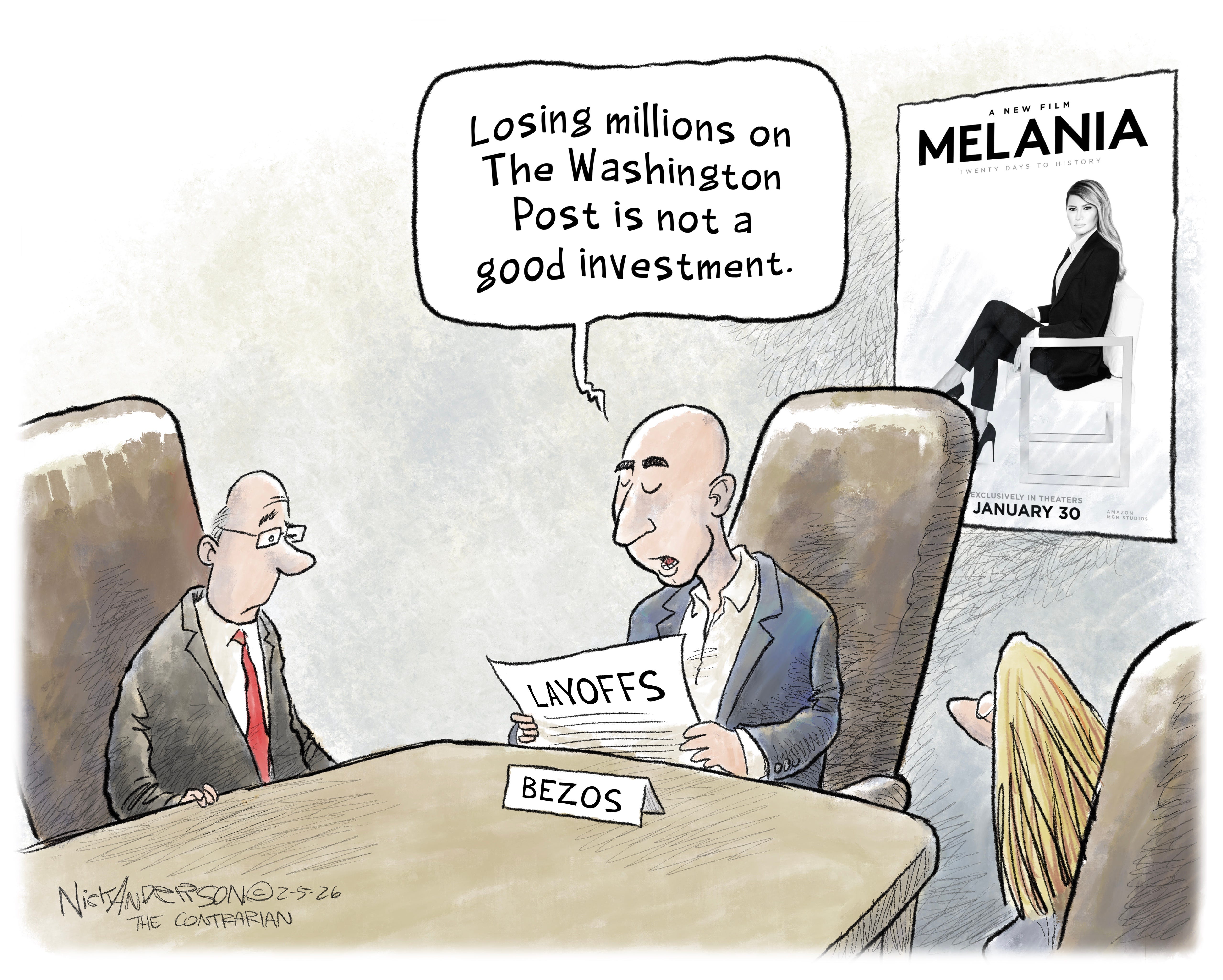
Jeff Bezos’ decision to slash roughly a third of the Washington Post’s newsroom is not just another media downsizing story. It is yet another blow to one of the most important pillars of American journalism at a moment when the country can least afford it.
While many readers had already canceled their subscriptions in protest of what they saw as the editorial page’s gutless appeasement of Donald Trump, I held on. I still depended on the Post’s daily reporting and, despite my frustrations, believed its daily reporting remained stronger than most of its competitors.
Today, I canceled my subscription.
For generations, the The Washington Post has been more than a newspaper. It has been an institution central to holding power accountable in the nation’s capital. Watergate. The Pentagon Papers. The relentless investigative reporting of recent administrations. Its reporting has shaped history and constrained abuses of power.
Now it is shuttering its sports desk, closing its Books section, suspending its flagship podcast, dramatically shrinking its international coverage, and laying off reporters covering war zones and the Middle East. The Metro desk—once the beating heart of a paper that proudly described itself as “For and About Washington”—is being cut down to a skeleton crew. This isn’t a “strategic reset.” It’s an abdication.
Bezos purchased the Post in 2013 as a civic-minded billionaire savior, promising innovation and long-term investment. Under executive editor Marty Baron, the paper flourished. It expanded its newsroom, grew to more than 3 million subscribers, and became a muscular check on the first Trump presidency.
Today, under the ownership of one of the wealthiest men on Earth—worth an estimated $261 billion—the Post is in full retreat.
The stated rationale is familiar: the industry is struggling, artificial intelligence is reshaping media, the numbers don’t add up. The paper reportedly lost $177 million over two years. But the scale and bluntness of these cuts raise a deeper question: What is the mission now?
When a publication like the Post pulls back from international reporting, reduces local coverage, and narrows its ambition, the loss isn’t merely internal. It affects citizens who rely on it to understand their government. It affects diplomats, policymakers, and watchdog groups. It affects voters.
Democracy depends on reporting that is independent, fearless, and well-resourced. It depends on journalists who can spend months digging into corruption without worrying whether their desk will exist next quarter. It depends on bureaus in war zones, on metro reporters who know their communities, on investigative teams that can follow paper trails wherever they lead. Hollow out those functions and something vital goes missing.
Former executive editor Marty Baron called this in a Facebook post “among the darkest days in the history of one of the world’s greatest news organizations.” He is not prone to melodrama. His warning matters. So does the fact that the reporter who covers Amazon—the primary source of Bezos’ wealth—was among those laid off. That detail alone feeds the perception that the Post’s independence may be narrowing along with its staffing.
Baron also said, “I remain personally grateful for Jeff Bezos’s steadfast support and confidence during my eight-plus years as The Post’s executive editor. During that time, he came under brutal pressure from Trump. And yet he spoke forcefully and eloquently of a free press and The Post’s mission, demonstrating his commitment in concrete terms. He often declared that The Post’s success would be among the proudest achievements of his life. I wish I detected the same spirit today. There is no sign of it.”
It is true that journalism is in crisis. Advertising revenue has evaporated. Audiences are fragmented. Technology platforms siphon off attention and dollars. But when an owner with virtually unlimited resources decides that contraction—not reinvention—is the answer, it sends a message. It says that the civic mission is negotiable.
At a time when political polarization is intensifying, when misinformation spreads at the speed of algorithmic outrage, and when powerful interests are increasingly hostile to scrutiny, weakening a major national newsroom is not neutral. It changes the balance of power. Again.
The Post once adopted the motto “Democracy Dies in Darkness.” It was more than a slogan. It was a commitment.
If the lights dim at one of the country’s most influential newspapers—not because of inevitability, but because of choice—then the darkness grows.
And when institutions that have long stood as bulwarks begin to hollow out, it isn’t just journalists who should worry. It’s every citizen who believes that power should be watched, questioned, and held to account.
The Washington Post is not merely another brand in a portfolio. It is part of the democratic infrastructure of the United States.
Dismantling it—piece by piece—weakens us all. I can only hope that something else rises in its place.
After years of subscribing to WaPo, I left over a year ago when Bezos announced they wouldn't endorse a presidential candidate, (knowing it would be Kamala Harris) and Jen Rubin and Ann Telnaes left the staff. I followed them immediately and never looked back.
Bezos is losing a lot of respect these days. With good reason.