
Smooth Exit

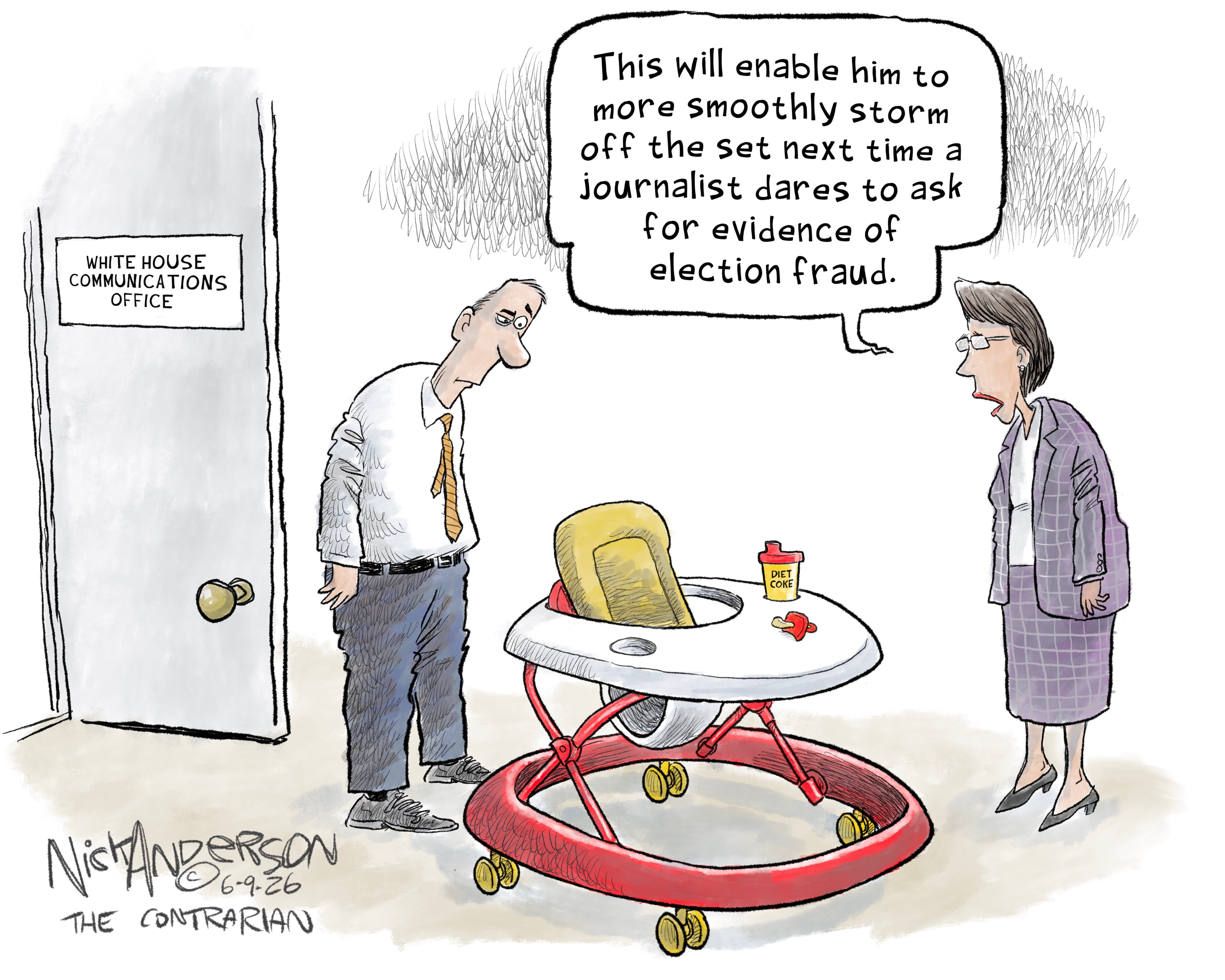
There are many ways a president can respond when asked for evidence. He can provide documents. He can cite court rulings. He can point to investigations, testimony, audits, or findings. Or, if those options prove unavailable, he can employ the time-honored statesman’s maneuver of calling the interviewer crooked and stomping off camera.
This week, Donald Trump demonstrated that leadership means never having to answer a question you don’t like. During a tense interview with NBC’s Meet the Press, Kristen Welker committed the grave journalistic offense of asking Trump whether he had evidence to support his claims of election fraud. Trump responded with what might generously be described as a screaming, red-faced tantrum. When Welker pointed out that simply looking at something is not, in fact, evidence, Trump accused her and NBC of being crooked before ending the interview altogether.
It was a fitting conclusion to a six-year national conversation about election fraud. Courts rejected dozens of post-2020 election challenges. Trump’s own Justice Department found no evidence of widespread fraud sufficient to change the outcome. Election officials, including Republicans, repeatedly certified the results. Yet somehow, after all this time, the strongest evidence apparently remains Trump’s ability to squint suspiciously at vote totals and declare, “Looks fishy.”
The interview became a master class in modern accountability avoidance. Asked for evidence, Trump attacked the question. Asked about court losses, he attacked the courts. Asked about facts, he attacked the network. Eventually, having exhausted every available target except reality itself, he attacked the microphone by removing it, stepping on it, and walking away. It was less a presidential interview than something one might witness at your local preschool.
Perhaps the most revealing aspect of the episode was not the walkout itself but the reason for it. Trump has spent years insisting that overwhelming proof of election fraud exists. If that were true, an interviewer asking for evidence would represent an extraordinary opportunity. Instead, it appears to have been treated as an act of aggression. In Trump’s political universe, evidence is always just around the corner, perpetually arriving tomorrow, much like infrastructure week or the replacement for Obamacare (“two weeks!”).
The scene offered a perfect metaphor for American politics in 2026. The president of the United States was asked to support one of his most consequential claims. Rather than provide proof, he denounced the referee and left the field. It was a reminder that Trump’s preferred version of accountability is much like his preferred version of elections: if he wins, the process is legitimate; if he’s challenged, somebody must be cheating.
And so America learned once again that the quickest way to end a debate about evidence is to remove yourself from the debate entirely. It may not be persuasive. It may not be presidential. But it does save an awful lot of time spent looking for facts.
I give Kristen Welker a lot of credit for trying to get Trump to engage on the subject of evidence; unfortunately, he doesn’t have any, knows what he’s saying is a lie, and continues to accuse the interviewer of being “crooked or stupid.” He couldn’t describe himself any more clearly than by those 2 words!
The walker chair in your great cartoon could double as a time out chair, often quite invaluable to diffuse a toddler-style tantrum!
Love the Diet Coke sippy cup!
If saying it makes it true, I would like to say I won the lottery without buying a ticket. What good is evidence anyway?