

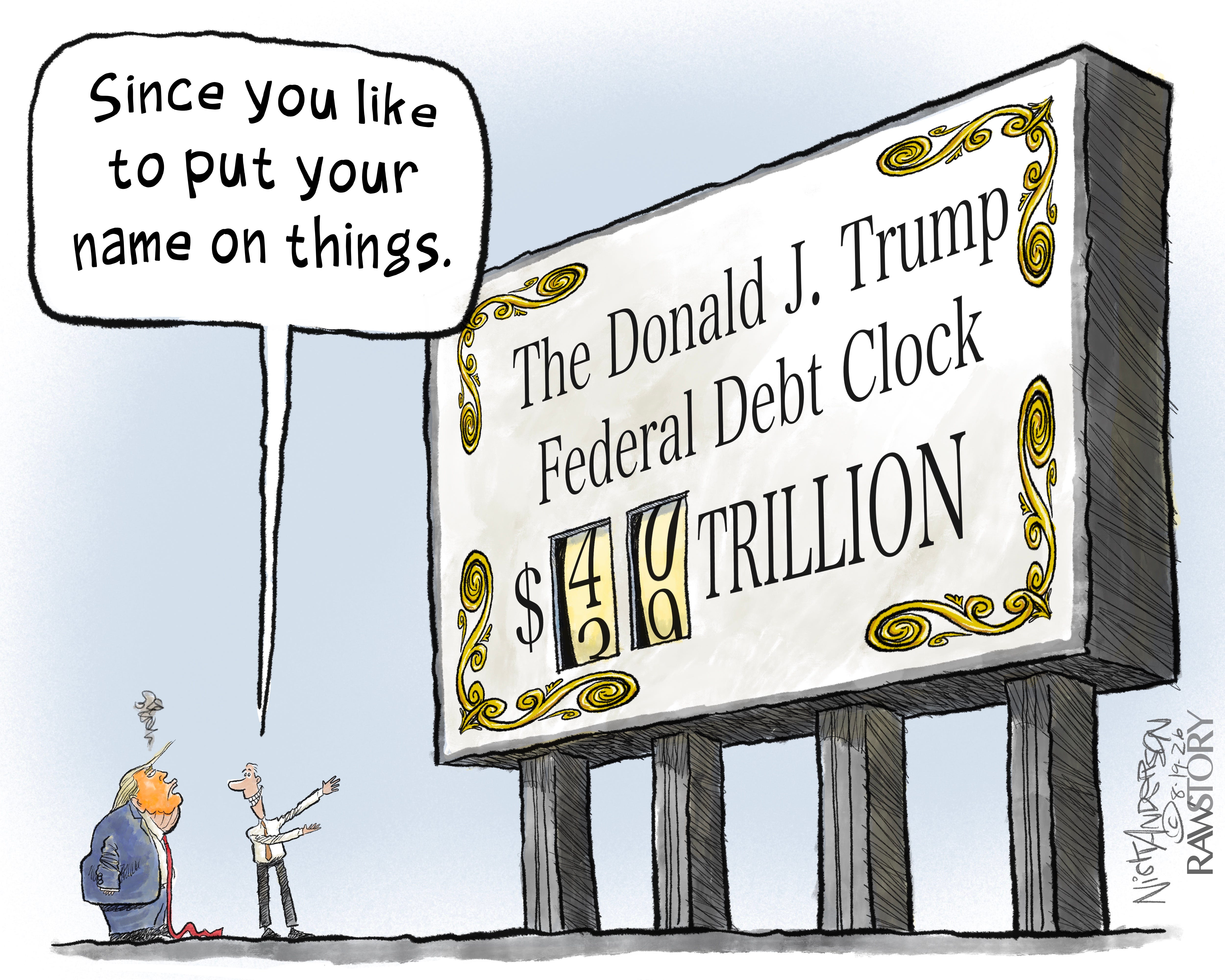
The United States is this week expected to cross a financial milestone that once seemed almost unimaginable: $40 trillion in national debt. The federal debt has doubled since first took office in 2017, and he’s added more to it than Biden. Critics may complain that this cartoon is unfair because both parties added to the debt. But Trump has certainly had more to do with creating the debt than he did the Kennedy Center.
The $40 trillion number itself is largely symbolic—there is nothing magical about crossing another trillion-dollar threshold—but the speed at which the government is reaching it tells a more troubling story.
Just six months ago, the Congressional Budget Office projected that debt would top out at about $39.4 trillion this fiscal year. Instead, Treasury officials now expect the nation to surpass $40 trillion almost immediately, driven in part by the loss of roughly $250 billion in anticipated tariff revenue after the Supreme Court invalidated President Donald Trump’s “Liberation Day” tariffs. To cover the shortfall, Treasury has accelerated borrowing, pushing the debt higher months ahead of schedule.
The timing could hardly be worse.
For years, investors treated U.S. Treasury bonds as the world’s safest asset, allowing Washington to borrow at relatively modest cost even as deficits ballooned. That assumption is beginning to look less certain. Concerns over inflation, global conflict, and growing sovereign debt around the world have pushed long-term Treasury yields to their highest levels in nearly two decades, meaning the government must pay substantially more to finance both existing debt and new borrowing.
The consequences are already becoming visible. Annual interest payments are projected to exceed $1 trillion this year—roughly equal to the Pentagon’s budget. Unlike spending on defense, infrastructure or research, interest payments purchase no new capability. They simply compensate investors for money already borrowed. Every additional dollar devoted to interest is a dollar unavailable for future priorities.
Because borrowing is occurring faster than expected, the government could reach the current $41.1 trillion debt ceiling by early next year, months sooner than many analysts anticipated. That raises the prospect of yet another debt-limit confrontation in Congress, where lawmakers will once again argue over borrowing authority to finance spending that has largely already been approved.
Ironically, the debt ceiling debate often obscures the larger issue. Raising the debt limit does not authorize new spending. It merely allows Treasury to pay bills Congress has already incurred. The real drivers of debt lie elsewhere: persistent budget deficits, repeated tax cuts without offsetting revenue, growing entitlement costs, rising military spending, and decades of bipartisan unwillingness to align government spending with government income.
Both political parties share responsibility for the trajectory. The debt has climbed steadily through Republican tax cuts under George W. Bush, the wars in Iraq and Afghanistan, emergency spending during the Great Recession, the 2017 Trump tax cuts, massive pandemic relief under both Trump and Biden, and more recent tax-and-spending packages. The Congressional Budget Office estimates that the 2025 One Big Beautiful Bill Act alone will add roughly $4.7 trillion to projected deficits over the next decade.
The current administration argues that stronger economic growth and efforts to eliminate waste, fraud, and abuse will eventually improve the nation’s debt-to-GDP ratio. Critics counter that economic growth alone is unlikely to offset deficits approaching $2 trillion annually, particularly as interest costs continue to compound.
Perhaps the greatest danger isn’t that the United States will suddenly default. Treasury has repeatedly navigated past debt-ceiling crises through accounting maneuvers and emergency cash management, and Congress has always ultimately acted to preserve the nation’s credit.
The greater risk is something slower and more subtle: an economy increasingly constrained by the cost of servicing yesterday’s borrowing. Every year that interest consumes a larger share of federal revenue, policymakers have less room to respond to recessions, wars, natural disasters or demographic challenges without borrowing even more.
Crossing $40 trillion isn’t the crisis. It’s a reminder that America’s fiscal challenge is no longer a distant warning. It has become an ever-larger feature of the federal budget itself. The milestone matters less because of the number than because it illustrates how quickly Washington’s margin for error continues to shrink.
Thank you for the serious commentary and cartoon.
So much more than the Kennedy Centre! It’s awful! When will people wake up!!! Thanks, Nick❣️