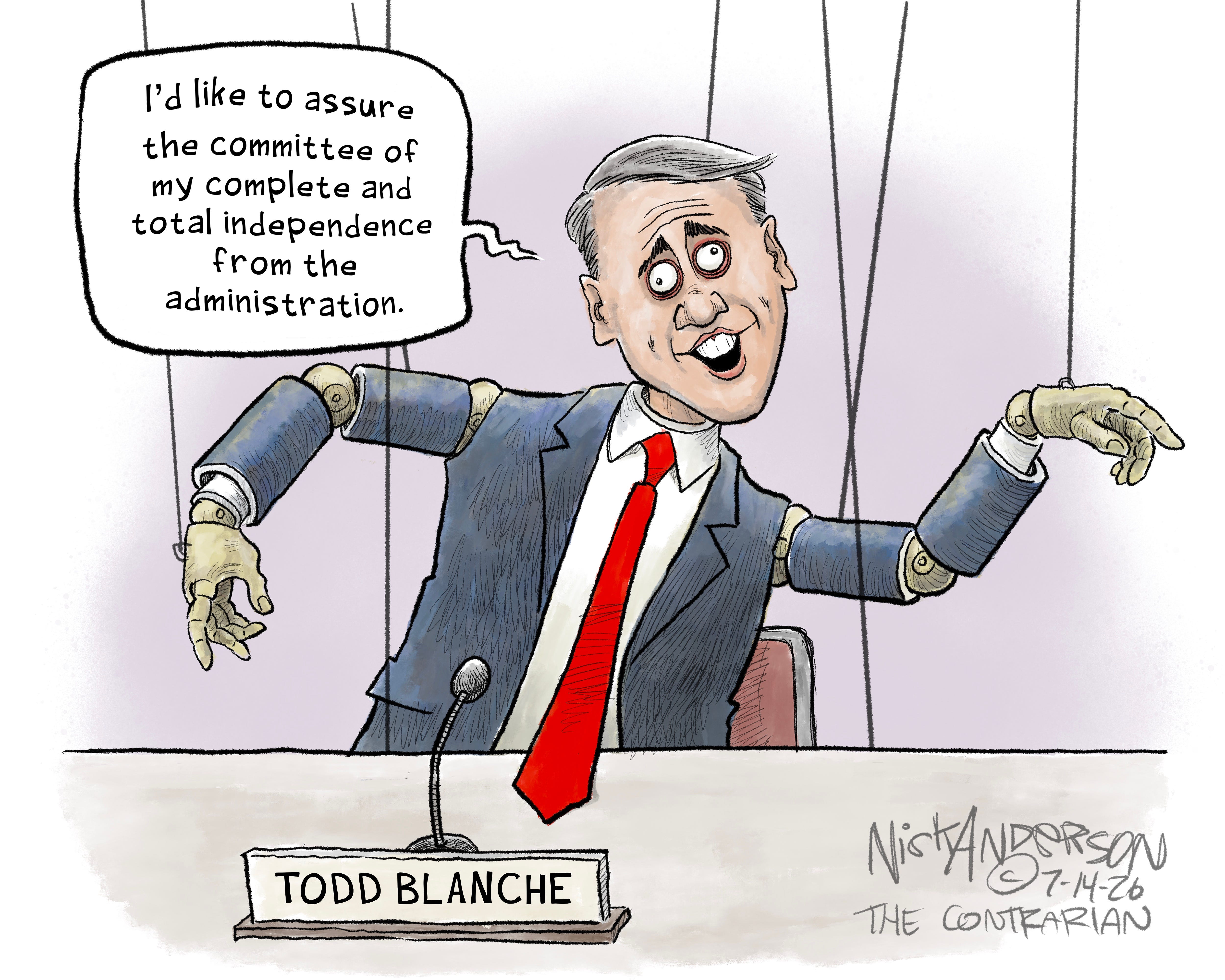
Todd Blanche
There was a time when Republicans and Democrats alike understood that the attorney general occupied a unique place in our constitutional system. The office exists to enforce the law, not the political wishes of the president.
Todd Blanche has demonstrated that he doesn’t believe in that distinction.
The former federal prosecutor has transformed himself into exactly what Donald Trump prizes most: a fiercely loyal defender willing to subordinate institutional independence to presidential power. That loyalty may make Blanche invaluable to Donald Trump. It makes him dangerous as attorney general.
An attorney general isn’t supposed to ask, “What does the president want?” He’s supposed to ask, “What does the law require?”
Again and again, Blanche has shown where his priorities lie. He has defended politically charged investigations of Trump’s critics. He has publicly embraced Trump’s claims that the Justice Department should answer directly to the president’s political agenda. He has echoed unsupported claims about the 2020 election despite the Justice Department’s own failure to produce criminal evidence supporting those allegations. Former colleagues who once praised his professionalism now openly question how completely he has abandoned the prosecutorial values they once shared.
That’s the tragedy of Todd Blanche.
This isn’t a case of an inexperienced lawyer rising beyond his abilities. By virtually every account, he once understood exactly what the Justice Department is supposed to be. He knew prosecutors wield enormous power. He understood that credibility is a prosecutor’s most valuable asset. He learned that justice demands independence from politics.
Then he met Donald Trump.
Some lawyers represent controversial clients. That’s not the issue. Every defendant deserves capable representation. But Blanche didn’t stop at being Trump’s lawyer. He became Trump’s enabler.
He defended investigations that appeared aimed at the president’s political enemies. He dismissed concerns about politicizing federal law enforcement. He embraced a vision of the Justice Department in which presidential wishes and prosecutorial decisions increasingly blur together. In doing so, he has helped normalize precisely the kind of Justice Department previous generations worked to prevent.
As deputy attorney general and later acting attorney general, Blanche repeatedly demonstrated that the Justice Department’s priorities would be whatever Donald Trump’s priorities happened to be that day. He defended investigations into Trump’s political adversaries while dismissing concerns that the department had become politicized. He publicly argued that presidential direction of the Justice Department should reassure Americans rather than concern them, a remarkable inversion of decades of bipartisan understanding that federal law enforcement must remain insulated from political influence.
Perhaps nothing better illustrates Blanche’s worldview than his response when questioned about Justice Department independence. Rather than acknowledge the department’s long-standing tradition of operating at arm’s length from the White House, Blanche reached for the Constitution and argued that executive power belongs to the president. Technically, that’s true. It is also beside the point. The Justice Department’s independence has never depended on a constitutional clause. It has depended on attorneys general who understood that not everything a president can demand is something an attorney general should do.
The damage has become increasingly visible.
Federal judges—who historically extended extraordinary trust to Justice Department lawyers—have begun openly questioning the department’s credibility. Courts have criticized prosecutors for misleading representations, unsupported claims and politically driven litigation. That kind of judicial skepticism is almost unheard of. Prosecutors are taught from their first day that credibility is their most valuable asset. Under Blanche’s leadership, that credibility has steadily eroded.
Then there are the controversies that seem to follow Blanche wherever he goes.
He became the public face of the administration’s proposed $1.776 billion “anti-weaponization fund,” a plan that would have compensated people claiming they were unfairly prosecuted—including January 6 defendants—until bipartisan outrage forced the administration to retreat. He has been criticized for his role in the Justice Department’s handling of the Jeffrey Epstein files, including decisions to redact names despite transparency requirements and a process that satisfied almost no one across the political spectrum.
Now, as Blanche seeks promotion to attorney general, even some Senate Republicans are uneasy. His confirmation hearing is expected to focus not simply on his qualifications, but on whether he has become too closely identified with Trump’s campaign of political retribution. Since becoming acting attorney general, Blanche has overseen investigations targeting several of the president’s perceived political adversaries, reinforcing concerns that the department is increasingly functioning as an extension of the White House rather than an independent law enforcement agency.
This nomination isn’t really about Todd Blanche. It’s about whether the Senate still believes the Justice Department should belong to the American people rather than to the president who happens to occupy the Oval Office.
The Framers gave presidents enormous power. They never intended to give them a personal law firm. The Senate should remember that before it hands Donald Trump exactly what he wants.


Not only is the cartoon brilliant, but the essay helped me understand more fully just what the real issue is. Thank you! Off to X...
The U.S. Attorney General is supposed to be for the people, not the president. He Should Not Be Confirmed.