
Another Spin?

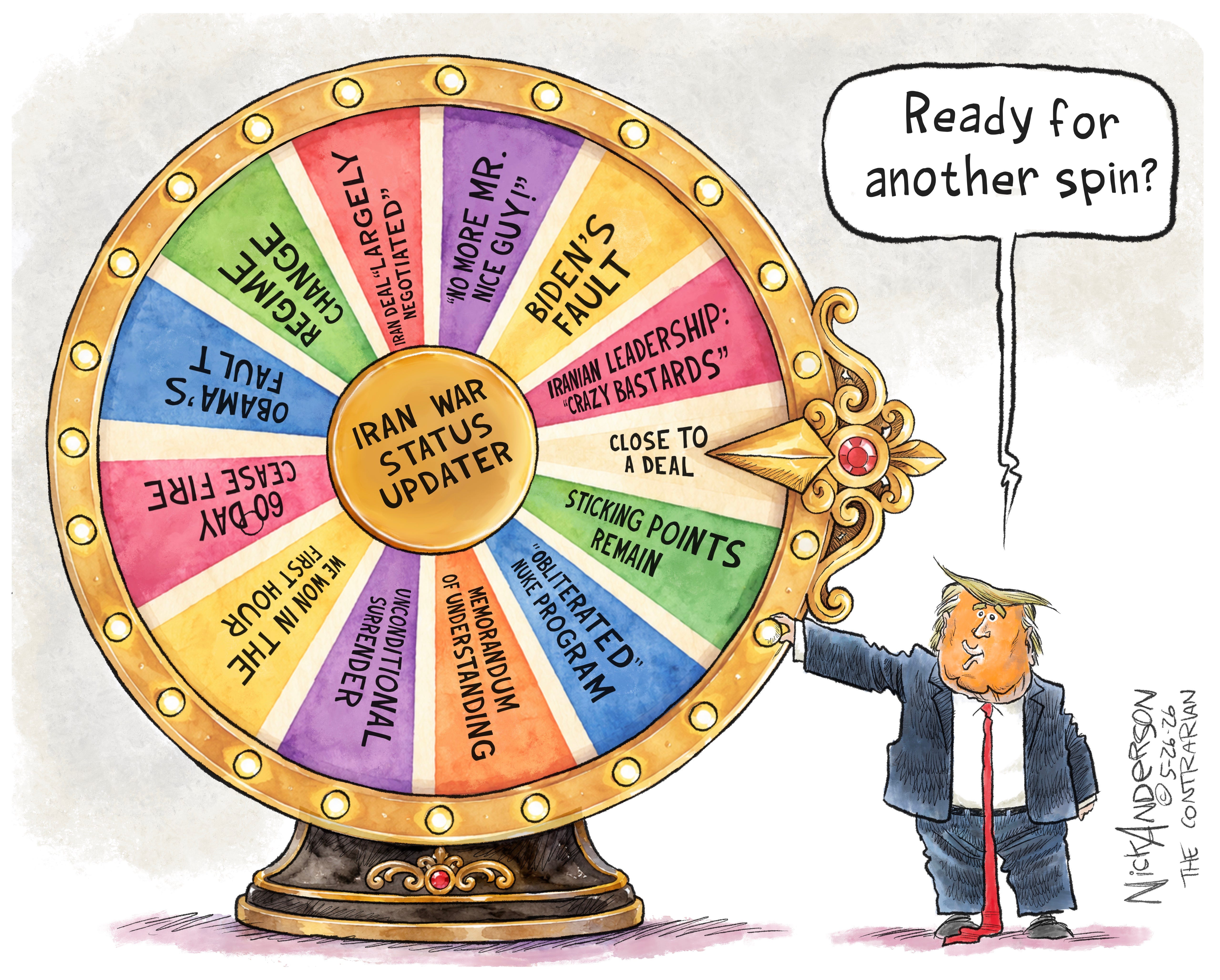
There’s a new tradition in Washington. Every few days, Donald Trump ends the Iran war. And then restarts it. And then ends it again. Sometimes before lunch.
At this point, the conflict isn’t being managed. It’s being narrated like a long-running TV series where the writers keep changing the ending mid-episode. Consider the timeline. The war will be over in three days. Actually, two weeks. Maybe a couple of days longer. No, wait... four to five weeks. Or possibly very soon.
It’s less a strategy than a rotating menu of deadlines. Pick one. Any one. They’re all equally binding, which is to say, not at all. And the contradictions don’t stop there. On the morning of April 1, the president predicted the war would be over within three days. By that evening, he was promising to hit Iran “extremely hard” for the next several weeks. So: finished. And escalating. Clear as mud.
Then there’s the Strait of Hormuz. At various points, it has been:
Critically important
Completely irrelevant
Something the U.S. has “nothing to do with”
A red line that must be opened immediately
A reason for a blockade
A problem other countries can “fend for themselves” on
It’s the geopolitical equivalent of saying, “This doesn’t matter at all, and if you don’t fix it immediately, there will be consequences.” Even the war’s objective has been… flexible.
Regime change? Yes.
Regime change? No.
Regime change? We never said that.
Regime change? It’s already happened.
At some point, you stop asking what the goal is and start asking whether there is one. To be fair, there is a certain logic here. If your policy changes often enough, you’re never technically wrong. You’re just early.
Predict a three-day war? That’s not incorrect. It’s simply a “dynamic timeline.” Threaten overwhelming force? That’s not escalation. It’s “strategic flexibility.” Back off hours later? That’s not a reversal. It’s “creating space for diplomacy.” Everything becomes defensible if nothing has to remain consistent.
The problem is that the rest of the world isn’t playing along. Allies are trying to interpret signals that contradict each other in real time. Markets are reacting to statements that may or may not still be true by the end of the day. Adversaries are watching a pattern emerge, one where threats are issued frequently and followed through on… less frequently.
And patterns matter. Because credibility isn’t built on any single statement. It’s built on consistency over time. When every declaration comes with an implied asterisk—subject to revision in the next news cycle—that credibility starts to erode.
Even former officials have noted how unusual this is, this constant shifting rationale, this real-time rewriting of objectives. “Unusual” might be putting it gently. There’s a difference between adapting to changing circumstances and improvising in public. This is the latter. And it comes with a cost.
Diplomacy becomes harder when your position isn’t stable. Negotiations become murkier when your goals aren’t clearly defined. And deterrence becomes weaker when your threats start to sound hollow.
Meanwhile, back home, Americans are left trying to answer a basic question: Are we in a war. The answer, apparently, depends on when you ask.
Morning: It’s ending.
Afternoon: It’s escalating.
Evening: It’s paused.
Next day: It’s over. Again.
At this rate, the Iran war may become the first conflict in history to conclude dozens of times without ever actually ending. Which, in its own way, is an achievement. Not a strategic one, but a rhetorical one. And in this administration, that increasingly seems to be the point.
It's so hard to take anything Trump says seriously. Thank goodness you are paying attention and writing about it, Nick!
Once again a thoughtful column. Thank you!