
Raising the Flag

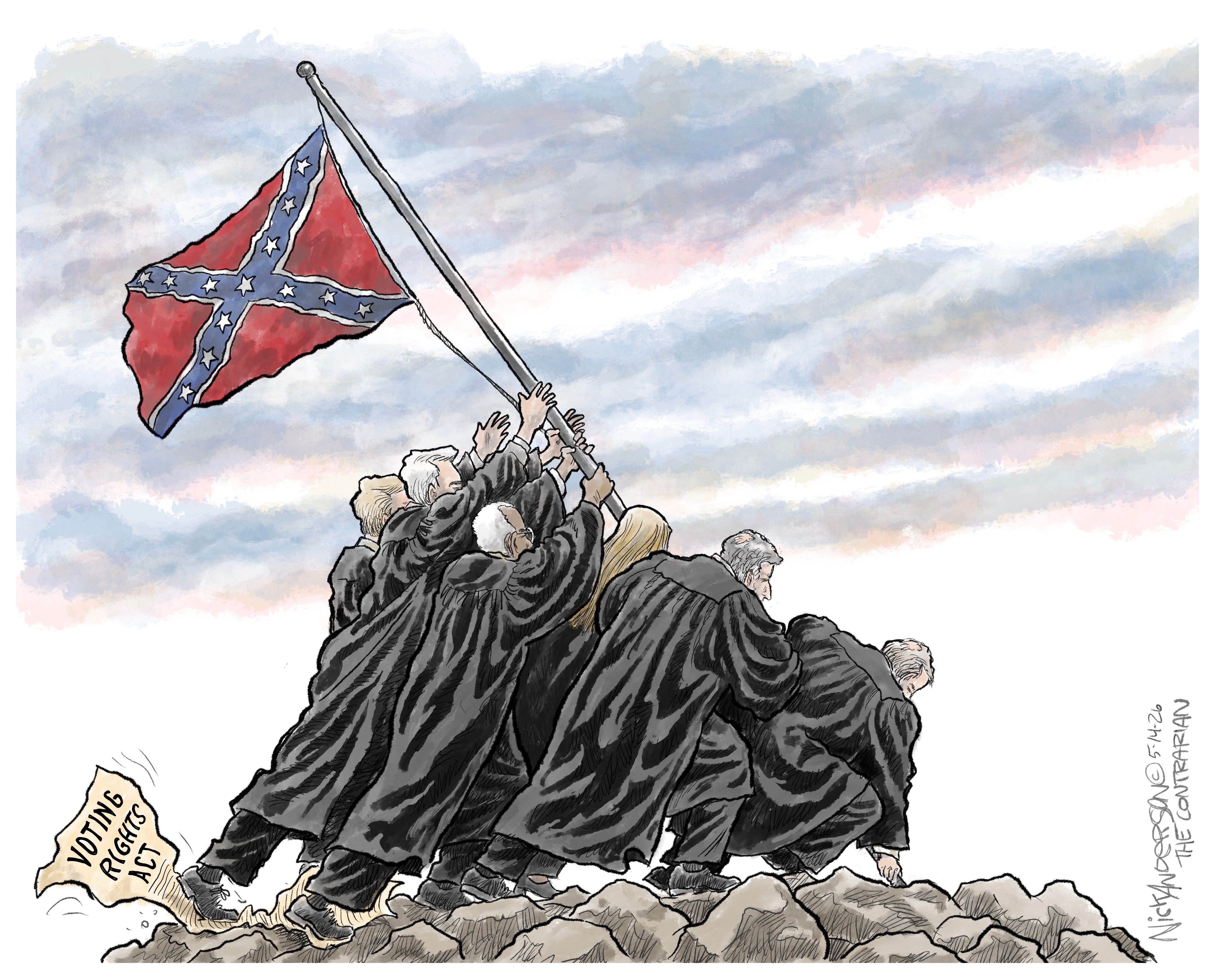
There’s a particular kind of decision that doesn’t just change the law. It rewrites the story we tell ourselves about the country. The Supreme Court’s latest ruling on the Voting Rights Act is one of those decisions.
In striking down what remained of protections against racial vote dilution, the court’s conservative majority didn’t simply narrow a statute. It made a far more sweeping claim, implicit but unmistakable: that the conditions that justified the law no longer exist. That the problem it was designed to solve has, more or less, been solved.
Or as the logic goes: racism in voting is no longer a serious concern, so the law guarding against it is no longer necessary. That’s not just legally dubious. It’s factually absurd.
The Court leaned heavily on a selective reading of history, pointing to two elections, 2008 and 2012, when Black and white voter turnout reached parity, to suggest that racial disparities had effectively disappeared.
Those elections, of course, featured Barack Obama on the ballot. Cherry-picking them as evidence of a permanent condition is like declaring winter over because you had two warm days in January.
More recent data tells a very different story. The racial turnout gap has not disappeared. It has widened. And not coincidentally, it has widened in the years since the Court began dismantling the Voting Rights Act piece by piece.
This isn’t speculation. It’s measurable. The Court’s 2013 decision in Shelby County v. Holder removed the preclearance requirement that forced jurisdictions with a history of discrimination to prove their voting changes wouldn’t harm minority voters. The Court insisted that Section 2—the remaining enforcement mechanism—would still provide protection.
Then, in 2021, the Court weakened Section 2. And now, with this latest decision, it has effectively finished the job.
The umbrella is gone. And the Court is assuring us it isn’t raining. But here’s the deeper problem. The one that extends beyond legal doctrine. This decision doesn’t exist in a vacuum. It lands in a political system that is already structurally tilted.
I’ve written about this before, but it bears repeating: Start with the Electoral College, which allows candidates to win the presidency while losing the popular vote. Add the United States Senate, where low-population states wield disproportionate power, states that, in today’s alignment, tend to lean conservative. Now add the redistricting wars which, thanks to the Virginia Supreme Court, are now tilted toward the Republicans.
Layer in a judiciary shaped by those same structural advantages. And now remove key protections against racial vote dilution in redistricting. At some point, the pattern becomes impossible to ignore.
This is not just about one ruling. It’s about an ecosystem of decisions and structures that collectively amplify the political power of a minority of voters, while constraining the ability of others to translate their numbers into representation.
Call it what it is: minority rule. Not absolute. Not uncontested. But increasingly entrenched. And the consequences are profound.
Redistricting—the drawing of political maps—is where power is locked in. It’s how temporary advantages become durable ones. By weakening the tools used to challenge discriminatory maps, the Court has effectively given state lawmakers more freedom to shape electorates rather than reflect them.
That’s not a theoretical concern. It’s a practical one.
It means that in closely divided states, maps can be drawn in ways that dilute minority voting power without meaningful federal recourse. It means that electoral outcomes can be engineered with greater precision. It means that the gap between votes cast and power exercised can widen even further. All while the Court insists the underlying problem has been solved.
There’s a famous line from Justice Ruth Bader Ginsburg’s dissent in Shelby County: throwing out the Voting Rights Act’s protections, she wrote, was like “throwing away your umbrella in a rainstorm because you are not getting wet.”
What we’re seeing now is the continuation of that logic. Except the rain didn’t stop. The Court just stopped looking.
Democracy doesn’t require perfect equality. But it does require a basic relationship between the will of the voters and the outcomes of elections. When that relationship breaks down, when structures and rulings consistently advantage one segment of the electorate over others, the system begins to lose its claim to fairness.
This decision accelerates that process. It tells lawmakers that the guardrails are gone. It tells voters that protections once considered fundamental are now optional. And it tells the country that the Court is willing to base its rulings not on current realities, but on a version of the past that is more convenient than accurate.
You can call that constitutional interpretation, or you can call it something else: A decision that doesn’t just weaken voting rights, but redefines reality to justify doing so.
Great depiction of what SCOTUS did with this latest ruling. Between gerrymandering and the electoral college, we're no longer a democracy. When the vote of someone in Wyoming counts more than mine in a blue state, that's just flat out wrong. One voice, one vote.
For some reason, seeing this brilliant cartoon with the 6 Justices attempting to stake a Confederate flag, reminded me how, back in January 2021, an upside down US flag flew over the home of Supreme Court Justice Samuel Alito. It was largely seen as support for the false claim, by President Donald Trump’s supporters, that the 2020 election had been fraudulent.
It doesn't appear that we've made much progress in our attitudes or beliefs since then; if anything, we're still litigating that "stolen election" and barreling backwards with lightning speed.
Love how the paper, which reads "Voting Rights Act," is stuck on the bottom of the Justice's shoe, soon to be lost and forgotten.
Superb blog, too.